
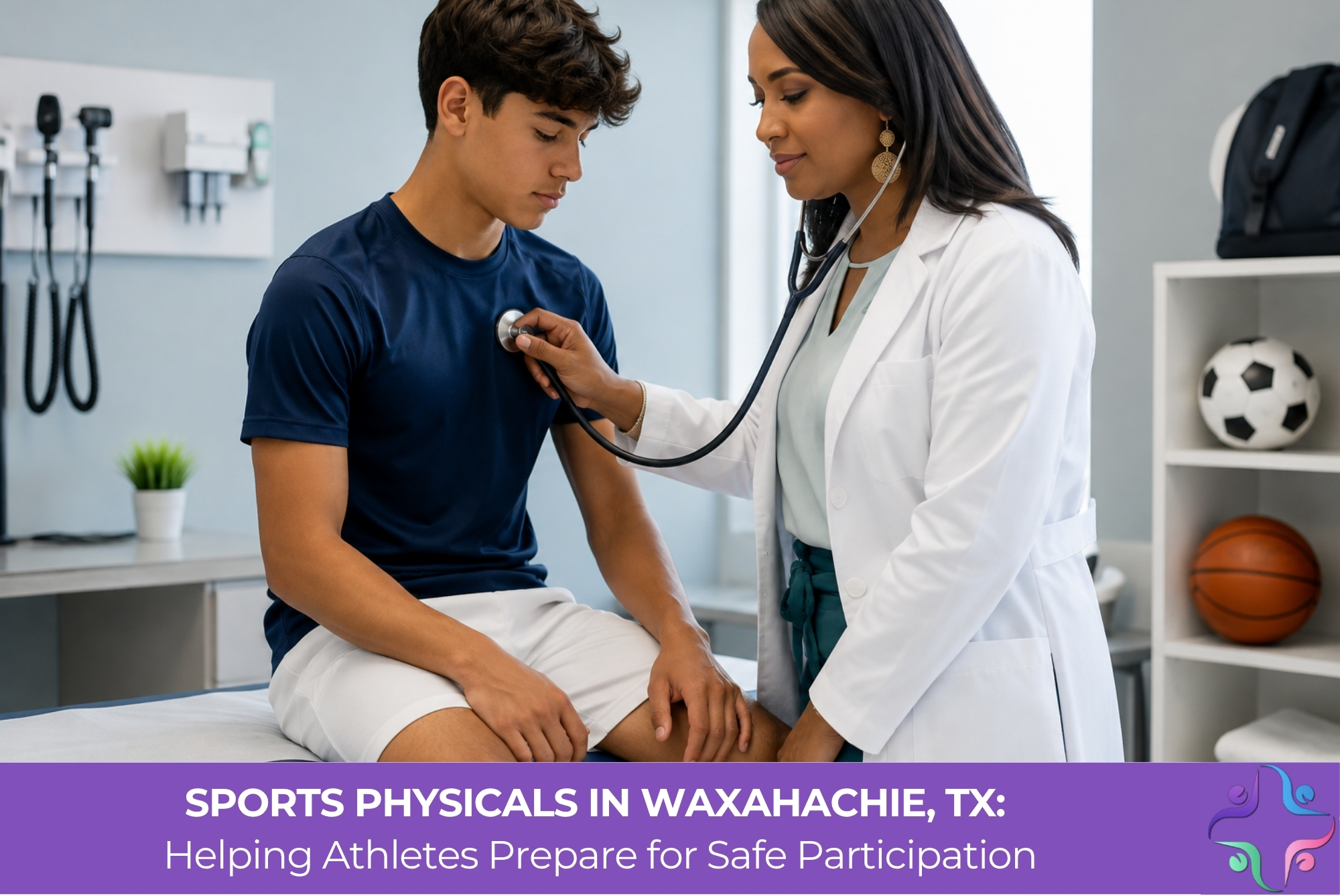
 Sports participation can be an important part of a healthy, active lifestyle for children, teenagers, and adults. Before an athlete steps onto the field, court, track, or other competitive environment, however, it is important to determine whether there are health concerns that may affect safe participation. A sports physical, also known as a preparticipation physical evaluation (PPE), provides an opportunity for a healthcare professional to review an athlete’s health history, evaluate physical health, and identify concerns that may require further assessment.
At Trinity Salem Family Health in Waxahachie, Texas, Yaminah Matthews, APRN, FNP-C, provides comprehensive sports physicals for athletes preparing to participate in school-sponsored and other athletic activities. The evaluation may include a review of medical and family history, vital signs, vision, cardiovascular and respiratory health, musculoskeletal function, and other areas relevant to athletic participation.
For families looking for sports physicals in Waxahachie, TX, scheduling an evaluation before the season begins can help provide enough time to address potential concerns and complete required participation paperwork.
What Is a Sports Physical?
Understanding the Preparticipation Physical Evaluation
A sports physical is a health evaluation designed to assess an athlete before participation in organized sports. In medical literature and professional guidelines, it is commonly called a preparticipation physical evaluation, or PPE.
The purpose extends beyond completing a school or athletic form. The PPE is intended to promote athlete health and safety and identify injuries, illnesses, symptoms, or risk factors that may warrant additional evaluation before participation. Major medical organizations, including the American Academy of Pediatrics (AAP) and American Academy of Family Physicians (AAFP), support incorporating the PPE into an athlete’s routine preventive healthcare when possible.
At Trinity Salem Family Health, a sports physical can include evaluation of vital signs, medical history, physical health, musculoskeletal function, and vision. Additional testing may be recommended when an athlete’s history, symptoms, or examination findings indicate that further evaluation is appropriate.
Why Are Sports Physicals Important?
Identifying Health Concerns Before Athletic Participation
Sports place unique demands on the body. Running, jumping, rapid changes in direction, physical contact, repetitive movements, endurance activity, and high-intensity exercise can challenge the cardiovascular, respiratory, and musculoskeletal systems.
A sports physical gives a healthcare provider an opportunity to identify concerns that could affect an athlete during these activities.
The AAFP notes that preparticipation evaluations are intended to promote athlete health and safety and identify individuals who may require further evaluation before participating. Recommended evaluations include attention to personal and family history, cardiovascular risk factors, previous musculoskeletal injuries, current symptoms, and mental health.
A sports physical therefore should not be viewed simply as an administrative requirement. It is an opportunity to evaluate an athlete in the context of the physical demands of sports.
What Happens During a Sports Physical?
Vital Signs and Basic Health Measurements
A sports physical commonly begins with basic health measurements. At Trinity Salem Family Health, the evaluation can include measurements such as height, weight, blood pressure, pulse, and other vital signs.
These measurements provide useful information about an athlete’s general health and may identify findings that deserve further evaluation.
Medical History Review
Medical history is a central component of a preparticipation physical evaluation.
Athletes and parents may be asked about previous diagnoses, surgeries, injuries, medications, allergies, chronic conditions, and relevant family medical history. Trinity Salem Family Health incorporates these areas into its sports physical evaluations.
Professional PPE recommendations also emphasize careful review of personal and family history, particularly information that may suggest cardiovascular risk or other conditions relevant to exercise.
Providing accurate and complete information is important, even when an athlete currently feels healthy.
Heart and Lung Evaluation
Athletic activity increases the workload placed on the heart and lungs. A sports physical therefore commonly includes evaluation of cardiovascular and respiratory health.
During the physical examination at Trinity Salem Family Health, the provider evaluates the heart and lungs along with other body systems.
Athletes should mention symptoms that occur during exercise, including unusual chest discomfort, fainting, unexplained shortness of breath, palpitations, or significant exercise intolerance. Such symptoms do not automatically mean an athlete cannot participate, but they may warrant additional evaluation.
Musculoskeletal Examination
Muscles, joints, ligaments, tendons, and bones experience significant stress during sports.
The sports physical at Trinity Salem Family Health may include assessment of joints, posture, flexibility, strength, limbs, and signs of previous or current injury.
The AAFP’s summary of PPE recommendations similarly emphasizes previous injuries and current musculoskeletal symptoms as important areas of evaluation.
Athletes should disclose lingering pain, instability, limited movement, weakness, recurrent swelling, or injuries that never completely resolved.
Vision Screening
Vision can affect performance and safety in many sports. Trinity Salem Family Health includes vision assessment as part of its comprehensive sports physical process.
If a potential vision problem is identified, corrective lenses or further evaluation may be recommended.
Additional Testing When Clinically Appropriate
Not every athlete requires laboratory tests, imaging, or other diagnostic studies as part of a routine sports physical.
When medical history, symptoms, or examination findings raise a concern, however, additional evaluation may be appropriate. Trinity Salem Family Health notes that potential diagnostic evaluations may include blood or urine testing, allergy testing, lung function testing, X-rays, or other imaging depending on the individual situation.
The appropriate evaluation depends on the athlete’s medical history and clinical findings.
What Health Issues Can Be Relevant to a Sports Physical?
Asthma and Exercise-Related Breathing Problems
Athletes with asthma or exercise-related breathing symptoms should discuss their history with their healthcare provider.
Symptoms such as wheezing, coughing, chest tightness, or unusual shortness of breath during activity may warrant evaluation. When asthma is appropriately assessed and managed, a healthcare provider can help develop a treatment strategy suited to the athlete’s individual needs.
Previous Sports Injuries
A history of injury is an important part of the sports physical.
Previous ankle sprains, knee injuries, fractures, shoulder injuries, back pain, muscle strains, or other musculoskeletal problems should be discussed, particularly when symptoms persist.
Trinity Salem Family Health also provides care for minor injuries, including sprains and strains, when medical evaluation is appropriate.
Cardiovascular Concerns
Preparticipation guidelines place particular importance on an athlete’s personal and family cardiovascular history.
Athletes should provide accurate information about symptoms such as unexplained fainting or near-fainting during exercise, exercise-related chest discomfort, unexplained palpitations, or unusual shortness of breath. Relevant family history should also be discussed with the provider.
A concerning history or examination finding may lead to additional evaluation before clearance.
Chronic Health Conditions
Having a chronic health condition does not necessarily prevent someone from participating in sports. The important issue is whether the condition is appropriately evaluated and managed.
Trinity Salem Family Health provides ongoing chronic disease management for conditions including diabetes, hypertension, high cholesterol, osteoarthritis, chronic migraines, and other health concerns.
Athletes with chronic conditions should discuss medications, symptoms, treatment plans, and any sport-specific considerations during their evaluation.
Mental Health and Athlete Wellness
Modern preparticipation evaluation recommendations recognize that athlete health includes psychological as well as physical well-being.
The fifth-edition PPE recommendations include attention to mental health, and the AAFP notes that screening for anxiety and depression symptoms should be included in the evaluation process.
This broader approach reflects an important principle: an athlete is a whole person, not simply a collection of muscles, joints, and vital signs.
When Should an Athlete Get a Sports Physical?
Schedule Before the Sports Season Begins
Families should avoid waiting until the final day before practices or tryouts whenever possible.
The American Academy of Pediatrics states that when a PPE cannot be incorporated into the athlete’s routine health supervision visit, it ideally should occur at least six weeks before the first preseason practice. This timing provides an opportunity to evaluate and address medical conditions identified during the examination.
Schools, leagues, athletic associations, and states may have their own requirements regarding forms, deadlines, and how frequently athletes need an examination. Families should confirm the requirements that apply to their athlete.
What Should You Bring to a Sports Physical?
Prepare Before Your Appointment
Being prepared can make the sports physical more efficient and help the healthcare provider obtain an accurate picture of the athlete’s health.
Bring any sports participation or school forms that need to be completed. It is also helpful to have an up-to-date list of medications, relevant medical records, information about previous injuries or surgeries, and details about important family medical history.
Trinity Salem Family Health asks new patients to bring available current or previous medical records and a list of current medications.
Parents of younger athletes may want to review medical and family history before the visit so they can answer questions accurately.
What Happens After a Sports Physical?
Clearance for Participation
If the evaluation does not reveal a concern that affects participation, the healthcare provider can complete the appropriate sports physical paperwork.
Trinity Salem Family Health notes that when the examination is satisfactory, the appropriate paperwork can be completed and provided to the patient.
When Additional Evaluation Is Needed
Sometimes a sports physical identifies an issue requiring further attention.
That does not necessarily mean the athlete will be permanently unable to participate. Depending on the concern, the next step could involve additional diagnostic testing, follow-up evaluation, treatment, specialist referral, vision correction, medication, a brace, or management of a condition such as asthma. After the problem has been appropriately evaluated or treated, clearance may still be possible.
The primary goal is to make an informed decision that supports the athlete’s health and safety.
Sports Physicals and Annual Wellness Exams Are Not Always the Same Thing
Understanding the Difference
Although sports physicals and comprehensive preventive visits can overlap, their purposes are not identical.
A sports physical is primarily focused on whether health conditions or injuries could affect safe athletic participation. A comprehensive wellness examination has a broader preventive-health focus and may address immunizations, chronic disease screening, mental health, preventive counseling, medication management, and other age-appropriate health needs.
Trinity Salem Family Health offers both sports physicals and annual wellness examinations. Its annual wellness services include physical examination, health screenings, vital-sign assessment, and other preventive services based on individual needs.
The AAP encourages sports physicals to be incorporated into routine health supervision when feasible because doing so allows athletic readiness to be considered within the athlete’s broader healthcare needs.
Sports Physicals for Student-Athletes in Waxahachie, TX
Supporting Athletes Across Different Sports
Different sports place different demands on the body, but athletes in many activities may need a preparticipation evaluation.
Sports physicals may be relevant for students participating in activities such as football, basketball, baseball, softball, volleyball, soccer, track and field, cross-country, tennis, wrestling, cheerleading, and other organized athletic programs.
Trinity Salem Family Health specifically provides sports physicals for athletes preparing for school-sponsored sports activities at its Waxahachie office.
Families should always verify their school or organization’s specific eligibility and documentation requirements.
Why Choose Trinity Salem Family Health for a Sports Physical in Waxahachie?
Patient-Centered Primary Care
Trinity Salem Family Health provides primary care services to individuals and families in Waxahachie, Texas. The clinic’s stated mission emphasizes high-quality primary healthcare, treatment, prevention education, and early identification of potential health issues.
Yaminah Matthews, APRN, FNP-C, is a certified family nurse practitioner whose primary care services include sports physicals, annual wellness exams, acute sick visits, immunizations, chronic disease management, and other family healthcare services. She earned her Master of Science in Family Nurse Practitioner from Winston-Salem State University and is certified by the American Academy of Nurse Practitioners.
For student-athletes and their families, having a sports physical performed in a primary care setting also provides an opportunity to consider athletic readiness alongside broader health needs.
The Bigger Picture: Sports Physicals Are About Athlete Health
More Than a Signature on a Form
It can be tempting to think of a sports physical as one more requirement to complete before the season starts. Clinically, its purpose is much more important.
A properly performed preparticipation evaluation gives athletes, parents, and healthcare providers an opportunity to discuss health history, previous injuries, current symptoms, cardiovascular concerns, respiratory health, musculoskeletal function, mental health, and other factors that could influence participation.
The AAP describes the PPE as a tool for helping promote safe participation in practice and competition, while multidisciplinary PPE guidance emphasizes a standardized approach to athlete health and safety.
The objective is not to unnecessarily keep athletes away from the sports they enjoy. It is to identify concerns, determine when additional evaluation is appropriate, and help athletes participate with a clearer understanding of their health.
Frequently Asked Questions About Sports Physicals
What is a sports physical?
A sports physical, or preparticipation physical evaluation (PPE), is a medical evaluation designed to assess an athlete’s health before participation in organized sports. It generally includes medical history and a focused physical examination.
Why does my child need a sports physical?
Schools, leagues, or athletic organizations may require a sports physical as part of participation eligibility. From a medical standpoint, the evaluation can also identify health conditions, symptoms, or previous injuries that may require attention before an athlete begins or continues strenuous activity.
Where can I get a sports physical in Waxahachie, TX?
Trinity Salem Family Health provides sports physicals at 1007 Legacy Ranch Rd., Suite 102, Waxahachie, TX 75165. Appointments can be requested online or by calling (972) 666-8111.
What does a sports physical include?
At Trinity Salem Family Health, a sports physical may include vital signs, medical history review, a comprehensive physical examination, musculoskeletal assessment, vision testing, and additional diagnostic evaluation when clinically indicated.
Is a sports physical the same as an annual physical?
Not necessarily. A sports physical focuses primarily on issues relevant to athletic participation, while an annual wellness examination addresses broader preventive healthcare needs. The AAP recommends incorporating the sports physical into routine health supervision when possible.
How long is a sports physical valid?
Requirements vary by state, school, league, and athletic organization. The AAP notes that PPE frequency is determined by state requirements. Families should check directly with their school or athletic organization regarding the applicable deadline and validity period.
How early should I schedule a sports physical?
It is helpful to schedule well before practices or tryouts begin. The AAP recommends that when the PPE cannot be completed as part of routine health supervision, it ideally occur at least six weeks before the first preseason practice so there is time to evaluate and treat concerns that may be discovered.
What should we bring to the appointment?
Bring required school or athletic forms, a current medication list, relevant medical records, and information about previous illnesses, surgeries, injuries, and family medical history. New patients at Trinity Salem Family Health are encouraged to bring available medical records and a current medication list.
Should an athlete mention an old injury even if it feels better?
Yes. Previous injuries are an important component of the musculoskeletal history. Athletes should discuss significant past injuries as well as ongoing pain, weakness, instability, swelling, or limitations. PPE guidance specifically emphasizes previous injuries and current musculoskeletal symptoms.
Can an athlete with asthma participate in sports?
Many people with asthma participate in athletics. An athlete with asthma or exercise-related respiratory symptoms should discuss the condition, symptoms, medications, and management plan with a healthcare provider. Individual recommendations depend on the athlete’s health and clinical evaluation.
What happens if something concerning is found?
A concerning finding does not automatically mean permanent disqualification from sports. Depending on the issue, the provider may recommend additional testing, treatment, follow-up care, or referral to a specialist before determining whether participation is appropriate.
Does every athlete need an ECG, X-ray, or blood test?
No. Additional diagnostic testing is generally based on medical history, symptoms, examination findings, and clinical judgment rather than automatically being required for every athlete. Trinity Salem Family Health may recommend testing when an identified concern warrants further investigation.
Why is family medical history important?
Family history can reveal potential inherited health risks that may be relevant to strenuous exercise. Professional PPE recommendations specifically emphasize reviewing personal and family history for factors associated with sudden cardiac death.
Can sports physicals identify every possible health problem?
No screening examination can identify every possible condition or guarantee that an athlete will not experience an illness or injury. A sports physical is one component of athlete health and safety. Athletes should continue reporting new symptoms or injuries even after they have been cleared for participation.
Should athletes report chest pain, fainting, or unusual shortness of breath?
Yes. Exercise-related chest discomfort, unexplained fainting or near-fainting, unusual shortness of breath, palpitations, or other concerning symptoms should be reported to a healthcare professional. These symptoms may require additional evaluation before athletic participation.
Can Trinity Salem Family Health evaluate sports-related minor injuries?
Trinity Salem Family Health provides evaluation and treatment for a variety of minor injuries, including sprains, strains, minor burns, cuts, abrasions, and puncture wounds. The appropriate level of care depends on the nature and severity of the injury.
Who provides sports physicals at Trinity Salem Family Health?
Sports physicals are provided by Yaminah Matthews, APRN, FNP-C, at Trinity Salem Family Health in Waxahachie, Texas.
How do I schedule a sports physical in Waxahachie?
Call Trinity Salem Family Health at (972) 666-8111 or use the clinic’s online appointment request page to schedule a visit.
Schedule a Sports Physical in Waxahachie, TX
A sports season should begin with preparation both on and off the field. A preparticipation physical evaluation can help identify health concerns that deserve attention, provide an opportunity to discuss previous injuries and medical history, and complete necessary participation documentation.
If you or your child needs a sports physical in Waxahachie, TX, contact Trinity Salem Family Health to schedule an appointment. The clinic provides patient-centered primary care and sports physical evaluations designed to support the health and well-being of local athletes.
Contact Information
Trinity Salem Family Health
1007 Legacy Ranch Rd., Suite 102
Waxahachie, TX 75165
Phone: (972) 666-8111
Website: trinitysalemfamilyhealth.com
Make an Appointment: trinitysalemfamilyhealth.com/appointments
Sports Physicals: trinitysalemfamilyhealth.com/sports-physicals/